Personal Fit
The science of a better fit.
Same meal. Different person. Different fit.
Most nutrition apps learn what you eat. Fithelia learns what works for you.
A useful food suggestion cannot come from the plate alone. Fithelia combines what it understands about the meal with what it knows about your preferences, your context and how similar choices have worked for you before.
A satisfying meal is more than a score.
Satiation
The processes involved in bringing an eating occasion to an end.
Satiety
The suppression of hunger after eating and the time before hunger returns.
Fithelia is especially interested in a practical question: will this meal work for this person in the period after eating? Fithelia does not claim to directly measure satiety; it learns from user-reported outcomes and patterns.
Start with evidence. Avoid simplistic formulas.
Research suggests factors relevant to satiation and satiety can include several parts of a meal and eating experience. No single universal formula explains every person or every meal.
- protein
- fiber, depending on type and food form
- food volume and energy density
- whole-food structure
- texture and food form
- oral processing and eating rate
- overall meal composition and structure
Processing labels alone do not fully describe the eating experience; food form, texture, eating rate, energy density and structure may matter.
Personalization begins with the meal itself.
Preserve the meal. Find the supported gap. Choose the smallest plausible complement.
The meal is only half of the picture.
Safety and compatibility
Dietary style, hard restrictions, and foods to avoid have strong priority.
Preferences
Foods liked, foods disliked, and sensory preferences help shape what may feel realistic.
Real life
Available time, effort preference, meal context, and current notes can matter more than generic defaults.
Personal history
Previous choices, explicit feedback, liked preparations, and patterns from similar meals add context.
Personal satiety
Later user-reported outcomes can become personal evidence when patterns repeat.
Fithelia learns cautiously.
One good meal does not become a universal rule. One negative outcome does not permanently ban a food. Fithelia treats personal history as evidence with different strengths. Repeated, consistent outcomes can increase confidence, while contradictory outcomes can reduce confidence. Explicit preferences may carry more weight than weak inferred behavior.
Personal history does not replace meal analysis. It calibrates it.
Population evidence starts the recommendation. Personal evidence calibrates it.
Same meal. Two different next decisions.
Example meal: pasta with tomato sauce.
Person A
Often wants something creamy, prefers minimal prep, and similar meals have tended to leave them hungry sooner.
Possible direction: a quick creamy or protein-containing side or addition that fits the meal.
Person B
Enjoys fresh, crisp foods, reports similar meals work well, and does not want much extra food.
Possible direction: a light fresh addition, or potentially no addition.
Recommendation is a ranking problem.
Fithelia generates multiple plausible meal-specific options. Those options can then be evaluated in the context of meal fit, compatibility, restrictions, preferences, convenience, effort, sensory fit, recent choices, and personal signals.
- meal fit
- compatibility
- restrictions
- preferences
- convenience
- effort
- sensory fit
- recent choices
- personal signals
The app initially presents three options and keeps three more available for variety.
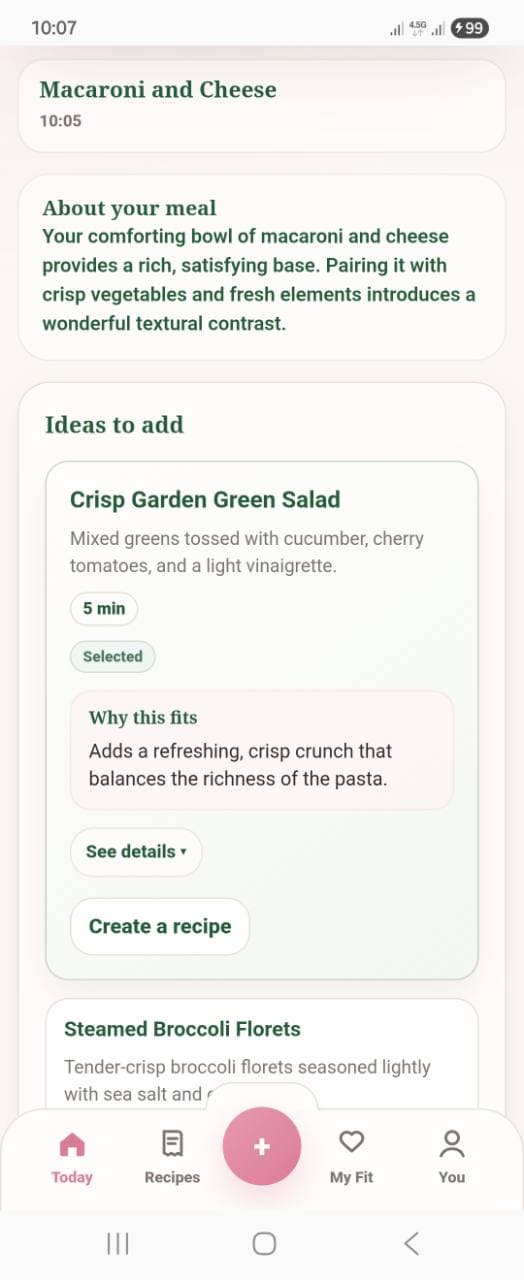
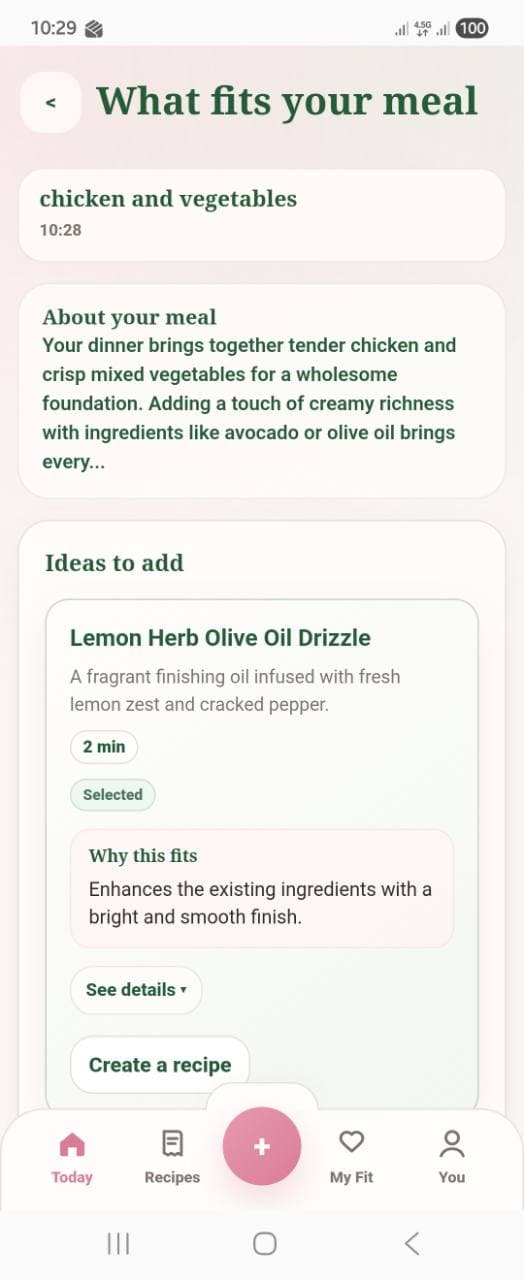
AI understands the meal. Fithelia learns the person.
AI models help interpret meal photos and text and support structured generation. Fithelia's own product logic combines that understanding with meal-fit reasoning, restrictions, contextual signals, personalization, recommendation ranking, and personal outcome history.
Personalization without turning food into homework.
- No calorie counting.
- No macro tracking.
- No rigid meal plans.
- No universal perfect meal score.
- No punishment for changing your mind.
Fithelia is designed to help with the next useful food decision.
The Personal Fit loop
- 01Understand the meal
- 02Find the useful gap
- 03Consider the person
- 04Rank plausible fits
- 05User chooses
- 06Learn from outcome
- 07Calibrate future fits
The best fit is personal.
Fithelia starts with nutrition evidence and meal understanding, then learns carefully from the person using it.
AI understands the meal. Fithelia learns the person.